
120) Anterior Ankle Impingement – Got Pain at the Front of Your Ankle?
That deep, pinching pain at the front of your ankle when you squat, lunge, or push off during a run isn’t something you should just push through. It’s a classic sign of anterior ankle impingement — and the good news is, with the right physio treatment, most people recover well. If it sounds familiar, keep reading, or book in with our team today.
Anterior Ankle Impingement Treatment in Frenchs Forest
At our clinic in Frenchs Forest, NSW, anterior ankle impingement is something we see regularly. Our patients include local runners training on the trails around Garigal National Park, gym-goers who squat and deadlift, tradies spending hours on uneven ground, and footballers whose ankles cop a beating week in, week out.
It’s one of those injuries that often gets dismissed as “just a sore ankle” — but left untreated, it can drag on for months and genuinely affect your performance and quality of life. If you’re in Frenchs Forest or nearby suburbs like Belrose, Davidson, or Forestville, we can help you get to the bottom of it quickly.

What Is Anterior Ankle Impingement?
Anterior ankle impingement happens when soft tissue or bony growths get pinched between the front of the shin bone (tibia or fibular) and the top of the foot (talus) during movement. It’s sometimes called “footballer’s ankle” because it’s common in sports that involve repeated dorsiflexion — that’s the motion of bringing your foot up toward your shin, like when you squat, climb stairs, or push off the ground when sprinting.
Over time, repetitive compression in this part of the joint can cause inflammation, scar tissue build-up, or even small bony spurs that make the problem worse. The result? A nagging, pinching pain at the front of the ankle that just won’t go away.
Common Symptoms
- A sharp or pinching pain at the front of the ankle, especially during squatting or deep lunging
- Pain or stiffness when walking downhill or descending stairs
- Reduced ankle range of motion — your heel comes up earlier than it should in a squat
- A sensation of something “blocking” at the end of ankle range
- Swelling or tenderness along the front of the joint
- Pain that eases with rest but flares up again with activity

What Causes It?
General causes
Anterior ankle impingement usually develops from a combination of:
- Overuse — repeated high-load activity that stresses the front of the ankle joint
- Load changes — suddenly increasing training volume or intensity without adequate build-up
- Previous ankle sprains — scar tissue and instability after sprains are a major contributor
- Muscle weakness or tightness — particularly in the calf and ankle stabilisers
Our clinic insights
In our experience, the most common cause we see in Frenchs Forest isn’t actually from a single dramatic injury — it’s the cumulative result of multiple old ankle sprains that were never properly rehabbed. Patients come in thinking they just have a “weak ankle,” but when we assess them properly, there’s a clear pattern of scar tissue and restricted motion that’s been building for years.
A mistake we often see is people blaming their technique when the real problem is a structural restriction. They spend months trying to fix their squat form or adjust their running gait, when the underlying issue is that the ankle joint simply doesn’t have enough range to work with.
Most patients are surprised to learn that bony spurs — while they sound scary — aren’t always the main pain driver. In many cases, it’s actually soft tissue impingement that responds really well to conservative physio treatment without any need for surgery.
Can You Keep Training?
This is one of the first things our patients ask, and the honest answer is: it depends on what’s being aggravated and how much.
For most people, complete rest is not the answer — and can actually slow your recovery by reducing circulation and allowing more scar tissue to form. That said, continuing to train through full-range squats or heavy running loads without any modification is likely to make things worse.
In our clinic, we generally recommend staying active but intelligently modifying your training. That might mean temporarily reducing squat depth, swapping runs for cycling, or adjusting loads while we work on restoring ankle mobility and strength. The goal is to keep you moving while giving the joint a chance to settle.
Getting a clear physio assessment early means you’ll know exactly what you can and can’t do — instead of guessing and potentially setting yourself back further.

How Physio Treats Anterior Ankle Impingement
Step 1: Assessment
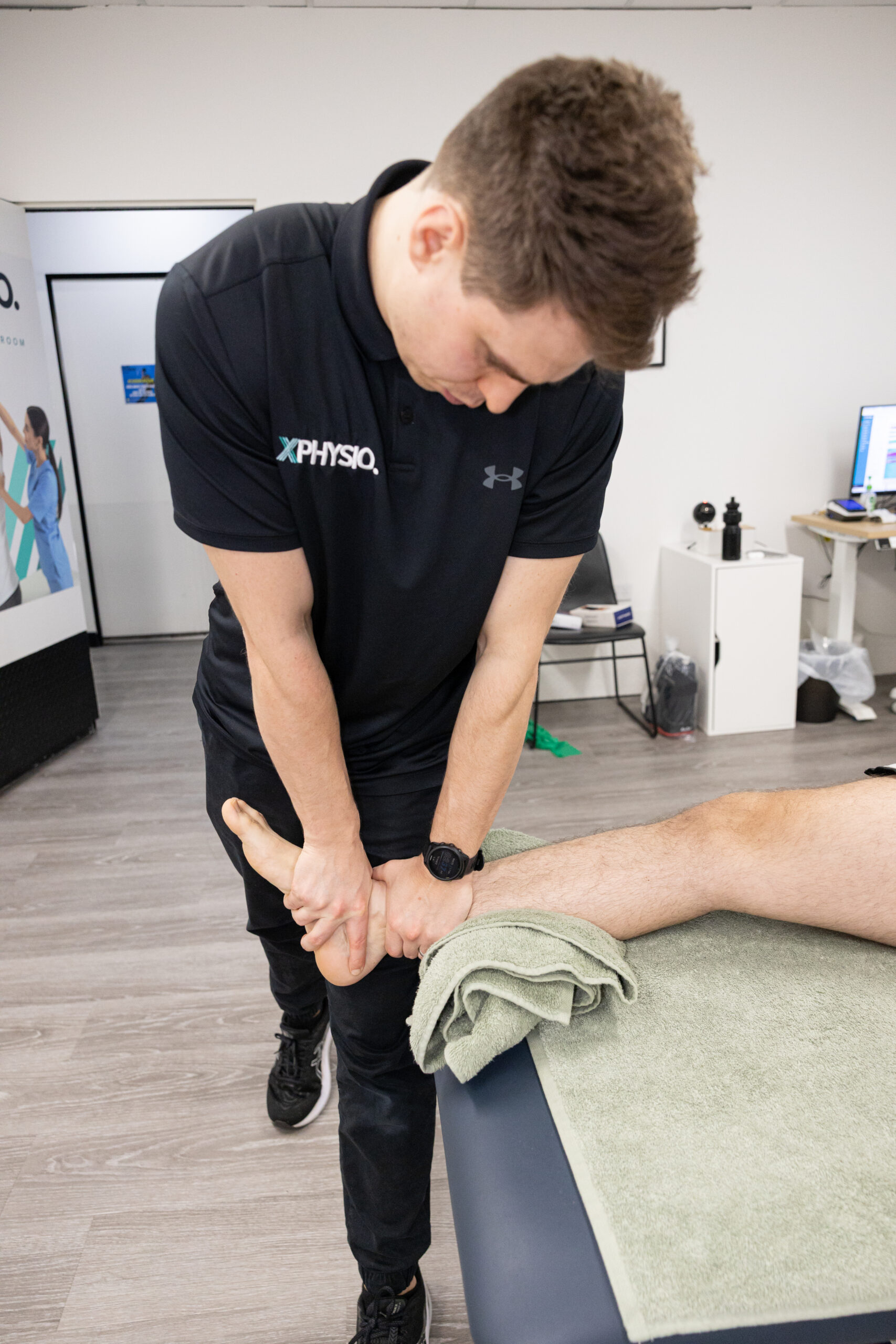
We start with a thorough assessment of your ankle mobility, joint mechanics, strength, and movement patterns. We’ll identify whether there’s a bony or soft tissue component, assess the degree of restriction, and look at contributing factors like calf tightness, hip strength, and foot mechanics. This gives us a clear picture of what’s actually going on before we start treating.
Step 2: Pain reduction
The early phase focuses on reducing inflammation and pain so you can move more freely. This might include hands-on joint mobilisation to restore ankle range, soft tissue work on the calf and surrounding structures, dry needling if appropriate, and activity modification to avoid aggravating positions.
Step 3: Strength and rehab
Once pain settles, the real work begins. We target the specific weaknesses that are loading the joint — usually the calf, peroneals, and hip stabilisers — and progressively build the ankle’s capacity to handle load again. This stage is often where people see the biggest improvements.
Step 4: Return to activity
We don’t just discharge you when the pain is gone. We make sure you can actually do the things that matter to you — whether that’s squatting at full depth, running a half marathon, or getting back on the footy field — without the problem coming back.
If you would like to explore more about how we prescribe exercise, CLICK HERE
If this sounds like what you’re dealing with, getting on top of it early with physio can make a huge difference. Book an appointment online here or give us a call on 9806 3077.
Why Rest Alone Won’t Fix Anterior Ankle Impingement
Here’s something most blogs won’t tell you: resting an impinged ankle without addressing the underlying cause is one of the least effective strategies. Pain might ease temporarily, but the restricted joint mechanics, scar tissue, and muscle imbalances that caused the problem in the first place are still there — waiting for you to load the ankle again.
We often see patients who’ve rested for weeks, felt better, then had symptoms return within days of getting back to training. That cycle is frustrating and unnecessary.
Effective recovery requires active intervention — restoring range of motion, improving joint mechanics, and building the strength to protect the ankle under load. Rest has a role in the early, acute phase, but it’s a starting point, not a treatment plan. This is exactly why working with a physio in Frenchs Forest who understands load management and ankle mechanics makes such a difference.

A Recent Patient Story
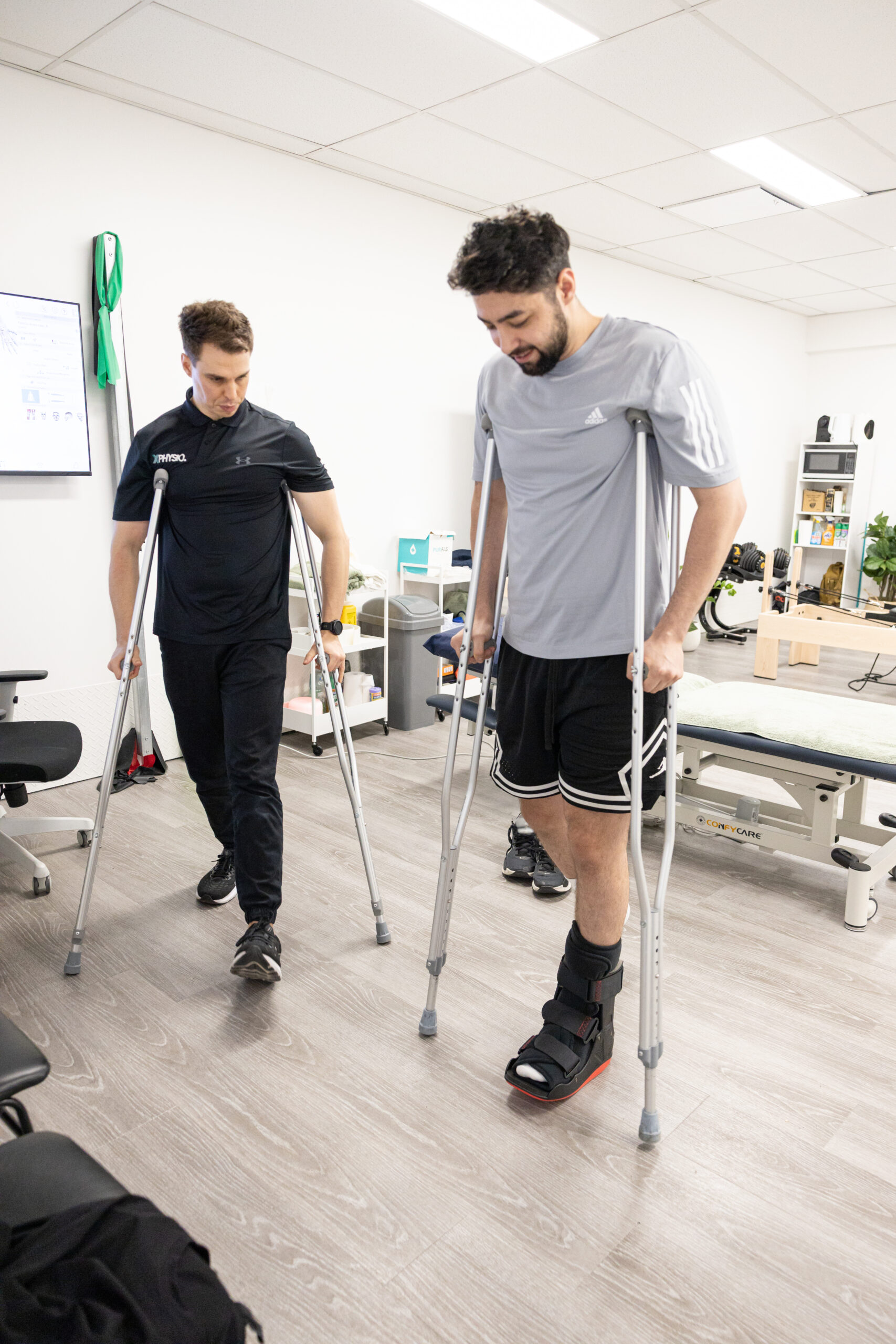
One of our recent patients — a tradie from Forestville — came in with eight months of nagging pain at the front of his right ankle. He’d tried resting it twice, bought new work boots, and even seen a GP who’d suggested it might be “just arthritis.” He was starting to resign himself to it being a permanent issue.
When we assessed him, we found severely restricted ankle dorsiflexion on that side, significant calf tightness, and a clear pattern of impingement pain at end range. There was no bony spur visible on imaging — it was a soft tissue impingement compounded by years of undertreated ankle sprains.
We worked on joint mobilisation, targeted calf and posterior chain loading, and gave him a progressive home program. Within six weeks he was pain-free on the tools. By week ten, he was back playing weekend cricket without any issues. He was genuinely shocked it could be resolved without surgery.
Common Mistakes That Slow Recovery
1. Ignoring it and training through full pain Pushing through sharp, pinching pain doesn’t build resilience — it drives more inflammation and can cause bony changes that complicate treatment. If it hurts, it’s telling you something.
2. Only resting without any rehab As we covered above, rest alone doesn’t address the root cause. Pain settles, then comes straight back when you reload.
3. Foam rolling and stretching the ankle aggressively Well-intentioned, but repeatedly forcing range in an already irritated joint can increase inflammation. Mobility work needs to be done strategically and progressively.
4. Self-diagnosing and skipping assessment Ankle pain has a number of causes — impingement, tendinopathy, syndesmosis issues, and more. Treating the wrong thing wastes time. A proper assessment takes the guesswork out.
5. Stopping rehab as soon as pain goes away Pain resolution is not the same as full recovery. Stopping too early leaves the underlying weakness in place and sets you up for recurrence. Check out our blog on running injury treatment to understand why completing your rehab matters.
How Long Does Recovery Take?
Most people with anterior ankle impingement see meaningful improvement within 4–8 weeks of consistent physio treatment. More complex cases — particularly where there’s a bony component or the injury has been present for a long time — can take 12 weeks or more.
We’ll always give you a realistic timeline based on your specific presentation at your first appointment. Some patients are back doing everything they want within a month; others with longer-standing issues need a more gradual approach. What we can say with confidence is that early treatment consistently leads to faster, more complete recovery.
Book In With Our Frenchs Forest Physios
If you’re dealing with anterior ankle impingement in Frenchs Forest or nearby areas — whether you’re in Belrose, Davidson, Forestville, Terrey Hills, or anywhere on the Northern Beaches — our physios can help you recover faster and prevent it from coming back.
We’ll give you a clear diagnosis, an honest outlook, and a practical plan to get you back to the activities you love.
Give us a call today on 9806 3077, or book online, just CLICK HERE.
Frequently Asked Questions
What does anterior ankle impingement feel like? The most common description is a pinching or deep aching pain at the very front of the ankle, particularly when you bring your foot up toward your shin — like at the bottom of a squat, walking downhill, or pushing off when running. Some people also notice a reduced range of motion and a feeling of something blocking in the joint.
Is anterior ankle impingement the same as an ankle sprain? No — though old ankle sprains are often a contributing cause. Impingement refers to soft tissue or bone being compressed between the joint surfaces, whereas a sprain involves stretching or tearing of ligaments. They’re different problems that require different treatment approaches.
Do I need a scan to diagnose ankle impingement? Not always. An experienced physio can make a strong clinical diagnosis based on your history, symptoms, and physical assessment. Imaging can be useful to identify bony spurs or rule out other pathology, but it’s not always necessary — and a positive impingement test in clinic is often more informative than an X-ray.
Can anterior ankle impingement heal on its own? In mild cases with adequate rest and load modification, symptoms can settle — but without addressing the underlying joint restriction and muscle weakness, the problem tends to return. Physio treatment significantly improves the speed and completeness of recovery.
Will I need surgery for ankle impingement? The vast majority of cases respond well to conservative physio treatment and don’t require surgery. Surgery (arthroscopic debridement) is generally only considered when conservative management has been thorough and hasn’t worked, or when there’s a significant bony spur causing the problem.
How many physio sessions will I need? This varies depending on how long you’ve had the problem and how complex it is. Most patients with straightforward impingement require between 4–8 sessions combined with a home exercise program. We’ll give you a clearer estimate after your initial assessment.
Give us a call today on 9806 3077, or book online, just CLICK HERE.
References
- Donnenwerth, M.P. & Roukis, T.S. (2012). Soft-tissue and osseous impingement syndromes of the ankle: role of imaging in diagnosis and management. Orthopedic Clinics of North America. https://doi.org/10.1016/j.ocl.2012.07.014
- Australian Physiotherapy Association (2024). Clinical guidelines for ankle and foot conditions. https://www.physiotherapy.asn.au
- Hess, G.W. (2011). Ankle impingement syndromes: a review of etiology and related implications. Foot & Ankle Specialist. https://doi.org/10.1177/1938640011415183
- Sports Medicine Australia (2023). Ankle injuries in sport: prevention and management. https://sma.org.au
- Tol, J.L. & van Dijk, C.N. (2004). Etiology of the anterior ankle impingement syndrome: a descriptive anatomical study. Foot & Ankle International. https://doi.org/10.1177/107110070402500212